
(Or at least for 173 uses)
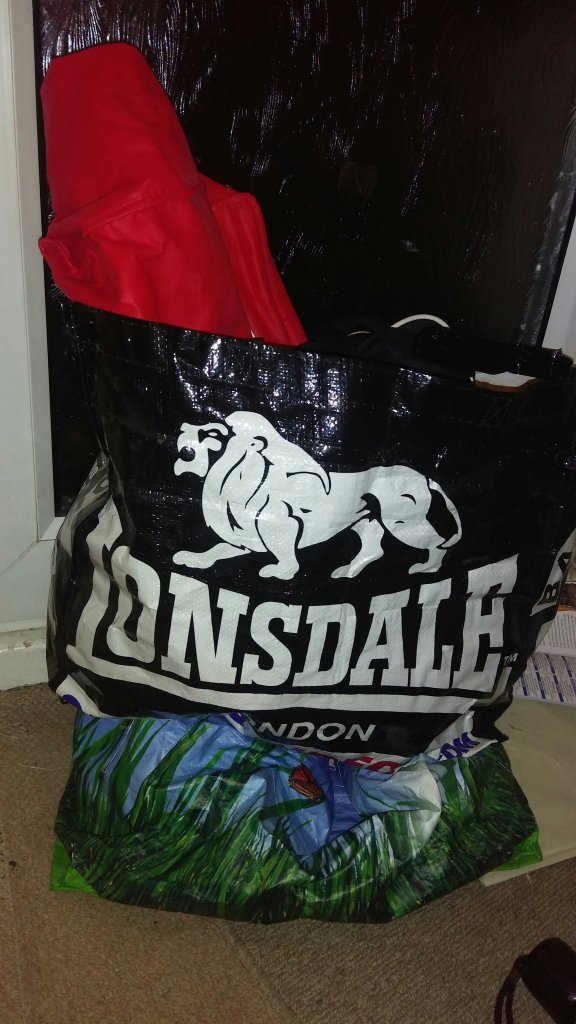
Inspired by a recent challenge to tackle your scariest places, we tacked under the stairs this week. Or maybe it’s more realistic to say that everything was pulled out & I was made to face my fears. Whatever. The unsurprising discovery, is that I have a bag problem. Not a handbag problem, a shopping bag problem. …And I don’t even like shopping. There were at least two rather large bags for life, containing nothing but more bags. And more than one large nappy bags. Houston, I have a problem.
In the UK, a law was introduced in October 2015 which required single use plastic bags to incur a charge in order to discourage their use. Obviously, I fully support this and I have been using re-usable bags as often as possible even before the charges started (in fact, the same law was introduced in South Africa before I moved, so taking bags with you when shopping was something I was already used to). While this is great for the environment, it is terrible for my clutter threshold. So, nappy bags aside, what do I have?
Well, there are the large thick woven plastic “bags for life”, mostly labelled with a supermarket brand. I don’t remember ever buying any of these. I think I accumulate them as I am given stuff. They are very useful as donatable donate bags, so I have to keep hold of them. (These are now *all* in the donate pile, fyi).
Then there are the less thick 10p bags for life, which are designed to be re-used a few times until the handle breaks – the ones you buy when the reduced section offers more treasure than you were expecting, so you need to buy another bag to transport your haul. I will now confess that I am keeping them as rubbish bags. This is not really good for the environment but surely better than going out and buying black sacks specifically for putting my rubbish in?
Next are the fabric bags. There are jute bags, cotton bags & hessian bags. There are bags with fun slogans, cute pictures and handy handles. For the most part, I have parted with them. It’s time to make a decision on what to keep, and go with *just* that. So we’ve got the bags Chris uses all the time (as he is the one who actually goes shopping. I just hoard bags.), and the Disney ones from Poundland. They are super useful, and not too big. We use them for pack lunch, PE kits, spare clothes for a day out, snacks for a day out, a nappy bag (because I don’t have 3 of those I can use) etc. A few other larger bags have been kept for when large bags are needed, but only the awesome one. I still have a problem, but the ridiculous pile is reduced.
So, what did I do with all of those bags I don’t want? They are still really useful, and have lots of life left! Throwing them away would be scandalous! But who would want a supermarket bag for life? I’ll tell you – your local charity shop! While some larger chains do not accept them (those that sell their own branded ones for example), most do. They will use them for customers who need a bag for what they buy. You can get really lucky in a charity shop! You go in for a quick nose and there you see something you’ve wanted for ages in great condition at a fantastic price….but you weren’t expecting it, so didn’t bring your extra large bag for life  . Have no fear! Nicky had a clear out, so we have a dozen to choose from. If you find yourself with too many bags for life with life left in them, please check with your local charity shop if they will take them. Great for your space, great for the environment, and great for the local community. Yay yay yay.

While we are talking about bags, I just wanted to take a moment to speak about the different ones you can get. I will not get technical, as I may get things wrong, so let’s speak broadly.
First up, there are plastic bags. “Single Use” plastic bags are made up of thin plastic. Going back several years, some stores decided to make theirs biodegradable. This may seem like a great idea but going to grab a bag and finding teeny tiny bits of plastic splintering off like confetti is not fun. Nor is it good for the environment. The plastic does not degrade completely, it just breaks up into pieces too small to see. Turns out this is just the kind of plastic particles being found in the oceans. It may not choke a dolphin but it is still poisoning the planet. These days, we’re seeing more “compostable” bags. They are not actually made out of plastic, but out of natural plant starch. This means that when they do degrade, they break down into organic matter, and not toxic material like plastic. I think compostable bags is an awesome idea for shopping bags. If you really do need to buy an extra bag when you get to the till, at least when you get home you can use it for your peelings & chuck it in the compost. Or, at least, not feel too guilty for filling it with rubbish & sending it to landfill. Although, please try use it for peelings & turn it to compost…
Cotton & canvas bags are much nicer than plastic. They are stronger, feel nicer, and, let’s face it, prettier. Obviously this is not a good thing when it means you start to accumulate them. But let’s consider if they are actually better for the environment? The cotton plant uses up a lot of water to grow. Then there is the energy costs involved in producing the bags. I’m all for breaking up with plastic but what are the environmental costs? Well, luckily I didn’t have to work it out myself, I just had to search. I managed to find an old report from the Environment agency, and they’ve crunched the numbers for me. It’s from 2006, but I don’t imagine it would have changed much.
Assuming you would only use a single use bag to carry your groceries home once, you would need to use a reusable bag:
- Paper bag – 3 Times ( Good luck with that)
- Low-density polyethylene bags (the thicker plastic bags commonly used in supermarkets) – 4 Times
- Non-woven polypropylene bags – 11 Times
- Cotton bags – 131 times
Assuming that once you got your groceries home, you then used the bag for rubbish, the numbers look like this:
- Paper bag – 4 Times
- Low-density polyethylene bags (the thicker plastic bags commonly used in supermarkets) – 5 Times
- Non-woven polypropylene bags – 14 Times
- Cotton bags – 173 times
So, I’ve made my choice, I choose cotton. I shall make it my mission to try use each of my bags at least 173 times. … Just don’t ask me to keep a tally.
So, what becomes of my precious cotton bags once they have reached the end of their usable life? Well, just like the compostable bags, I can use them for my peelings, & add them to the compost heap. They may take a bit longer to decompose but it will happen. But I don’t think I’ll do that. I’m quite in favour of using them as planters. Now, I am by no means green fingered, but I’m hoping that by the time my first bag reaches 172, I’ll have learned to keep something green alive by then. Who knows, we could have a Disney Princess powered vegetable garden some day! Well, we can only hope. ❤


I think that quilters have been trailblazer during the decades. Some examples:
Quilted hand bags and toiletry bags
In Finland we reuse empty coffee bags! My wife shows You:
How to make bags from empty coffee bags
How to make evening bag from empty coffee bags
Do You reuse empty tea bags?
Happy weekend!
LikeLike