

Greetings! This week the kids are home for half term, so even though I have tried something new I can’t wait to tell you about, typing time is short. (A bit like childhood – my baby is walking! *cue “Sunrise, Sunset” in the background.)
So instead, I’ll share a quick recipe with you. I say quick but it’s something that does actually require a bit of time. This week we’re making stock! We’ve been making stock for many years so it’s not exactly part of the “goes natural” journey. I can’t remember what made us start but once we saw how easy it was, we hardly ever let good bones go to waste anymore. I say “we” but my husband actually makes it 99% of the time.
For those who don’t know, stock is a liquid that’s used in cooking. It is used in lots of different dishes and adds flavour. You can make different types depending on what you use but most commonly we make chicken stock. I have made vegetable stock before but it was so long ago I honestly can’t remember how I did it. I am almost certain I used leftover vegetables. If I find myself doing it again I will be sure to share.
Stock cubes are readily available in supermarkets so why would you want to make your own? Well, several reasons. In no particular order:
- Fresh tastes best! When you make it yourself, you can add different flavours and play around with it. Nothing beats proper scratch cooking in my opinion!
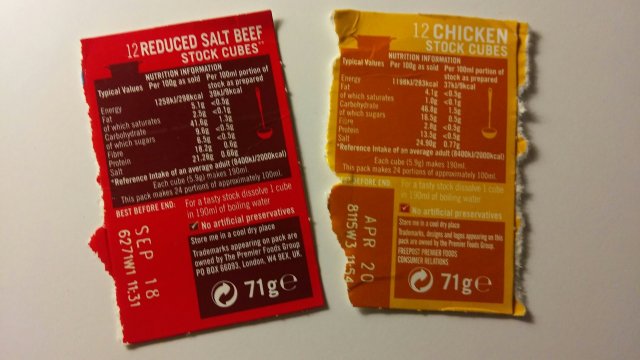
- It’s healthier. For one thing stock cubes are loaded with salt. I’ve just grabbed the nutritional information pieces from two boxes of stock.
If you make it per the directions, 100ml of chicken stock will contain 0.77g of salt. When I cook something with stock, I need a lot more than 100ml. If I used 500ml to make a pie, that pie would have 3.85g of salt in it, before any of the other ingredients were taken into account. The “reduced salt” beef cubes aren’t much better offering 0.66g of salt per 100ml. Yikes!
I have not had my stock scientifically tested, but no salt is added at all to the process. Any salt would come naturally from the ingredients, or the seasonally originally used on the meat the first time it was cooked. As you are using it fresh, there is no need to add a preservative. and there are SO many more options available for flavour! - It reduces waste. This is probably my favourite part. If you’ve just enjoyed a roast chicken hopefully you will use the leftovers for something. We had great chicken mayo sandwiches this week. But what about the bones? Chicken bones aren’t safe for pets, so chances are most likely discarded. Our council currently only take food waste with garden waste, which is a service we don’t pay for, so for us that carcass would go to landfill. But by making stock, you are taking that “rubbish” and making something worthwhile out of it. You would still need to chuck out the bones once you’re done, *but* at least you’ve given it one last run for it’s money.
- Talking of money, making stock is cheaper. Stock cubes are not expensive, but the fact that you are instead using leftovers, makes home made almost free. (I know you could argue that case, but I’m going with it…)
- Control – not only can you control what’s in it but also the end product. Things like the clarity (which may be important depending what you are doing with it) and the reduction. Adding boiling water to a crumbled cube will pretty much only ever give you one result.
What can you do with the stock? Lots of things! I am not google, but here are a few of my favourite things to make with home made stock:
- Risotto. As it happens that’s what will be happening to the batch made this week. Bacon & mushroom, thanks for asking 😉 . (And it always tastes better the next day)
- Soups. Any soup will need a stock base. That’s pretty much what it is. If you’re making soup, it will usually need a clear stock.
- Pies. I tried to perfect a pie recipe, but I just hated making the pastry. But I think I mastered the filling. Make a roux, then pretend you are going to make a white sauce, but use stock instead of milk. Use that to coat the filling – I recommend chicken & mushroom. Ah-mazing!
- Chowders. Like soup, only better. I make a wicked corn chowder.
- Ramen. This requires clear stock. I have never made this, for the record.
So, how do you make it? You will need (for a basic meat stock, not clear)
- A large pot (my biggest pot is known as the Stock Pot)
- Bones. eg. leftover from a Roast.
- An Onion
- A Carrot
- Celery (optional but commonly called for)
- Cloves
- Your choice of seasoning. May we suggest:
- Nutmeg/Paprika/Cinnamon
- Black Pepper
- Fennel
- Other strong flavours you think will go with what you’re making.
Add all the ingredients to the pot. Cover with water, get to the boil, then turn it down and allow to simmer for several hours. Keep checking on it as it’s cooking and skim the fat off the top. It will bubble up to the top then start forming a thin layer which you can remove with a spoon as you go. When the liquid is reduced to your satisfaction*, drain it through a sieve. Pretty please remember that it’s the liquid you want to keep. You’re not draining the potatoes here, so if you sieve it over the sink after all that, you will cry – and it won’t be the onion. As for the leftover solids, that would need to go in the food waste, or bin. As far as I know cooked food can’t go into home composting (I’m trying to learn more about that though, so watch this space).
Allow the stock to cool then cover & keep it in the fridge until you need it. I try to use it within a few days but I will leave that to your judgement. It is also freezable! If you have bones to use but no opportunity to use the stock, make it anyway and keep it in the freezer. You can also freeze the bones to make stock at a later date. I’ve never tried that though.

Something new that’s been tried though, is adding oils** for flavouring. I normally don’t like the smell of stock cooking, but this latest batch smelled rather nice, like something yummy was cooking. It turns out that my husband had added a drop of Rosemary oil! I’ll admit I bought it for a hair spray, but it is definitely going to be a favourite in the kitchen! Other oils we’re currently trying in the stock:
- Clove
- Fennel
- Lemon
That’s all from this “quick” post. If you make or use home made stock, share with us your favourite recipe!
Notes: *Knowing how you like it takes a bit of practice. Just keep making it and you’ll get the hang of it. Even an imperfect batch will be good enough to use!
**I will only use doTERRA oils for cooking, as I know they are pure, tested and safe. Not all oils are safe for consumption, please check the label first. If you do not yet have an account, get one here. Click “Join & Save” to get the best prices.
 Nicky Goes Natural